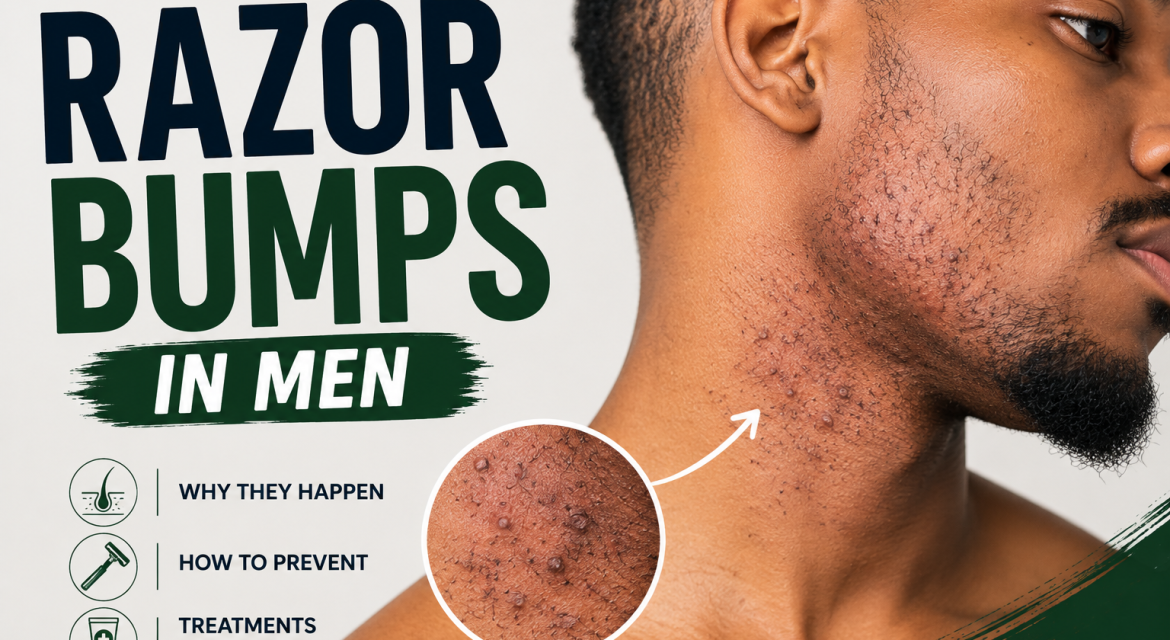
Razor bumps are more than just a shaving problem. If you regularly develop small, itchy or painful bumps around your beard, neck or jawline after shaving, you may be dealing with pseudofolliculitis barbae (PFB)—commonly known as razor bumps or shaving bumps.
The condition is particularly common in men with coarse, tightly curled hair. When a shaved hair curves back into the skin, it can trigger inflammation and create bumps that may eventually leave dark marks or scars.
For men with darker skin, treating razor bumps correctly is especially important because repeated inflammation can lead to persistent post-inflammatory hyperpigmentation.
What Are Razor Bumps?
Razor bumps occur when recently shaved hairs grow back into the skin rather than straight out of the hair follicle.
The body recognizes the ingrown hair as an irritant, triggering inflammation.
You may notice:
- Small red or dark bumps
- Itching
- Burning after shaving
- Tenderness
- Pus-filled bumps
- Ingrown hairs
- Dark marks after the bumps heal
- Raised scars in more severe cases
Razor bumps are different from ordinary razor burn. Razor burn is usually irritation of the skin caused by shaving, while razor bumps involve hairs growing into or against the skin.
Why Do Some Men Get Razor Bumps?
Hair type plays a major role.
Coarse, curly hair is more likely to curve back toward the skin after being cut. This is why pseudofolliculitis barbae is particularly common among men with tightly curled facial hair.
Shaving can make the problem worse because a very close shave leaves the hair with a sharp tip. As the hair grows, that tip can curve back and penetrate the surrounding skin.
Other factors can include:
- Shaving too closely
- Shaving against the direction of hair growth
- Stretching the skin while shaving
- Using a blunt razor
- Shaving too frequently
- Applying excessive pressure
- Repeated irritation
- Certain hair-removal methods
Why Are Razor Bumps Common on the Neck?
The neck is one of the most difficult areas to shave because facial hair may grow in different directions.
When you shave against the direction of growth, you can achieve a very close shave—but this can increase the chance that curly hairs will grow back into the skin.
For this reason, repeatedly shaving the same area very closely can create a cycle:
Shaving → ingrown hair → inflammation → bump → dark mark → shaving again → more irritation.
Breaking this cycle is an important part of treatment.
How to Prevent Razor Bumps
You don’t necessarily have to stop shaving completely.
Changing your shaving technique can significantly reduce irritation and ingrown hairs.
1. Avoid an Extremely Close Shave
A very close shave may look smooth immediately, but it can increase the likelihood of hairs growing back into the skin.
Consider using an electric trimmer or shaving tool that leaves a small amount of hair rather than shaving completely against the skin.
2. Shave in the Direction of Hair Growth
Look carefully at the direction your beard grows.
Instead of automatically shaving upward on the neck or against the grain, shave with the direction of hair growth.
This may not produce the closest possible shave, but it can reduce irritation and ingrown hairs.
3. Don’t Stretch Your Skin
Pulling the skin tight while shaving can cause the hair to retract beneath the surface after it is cut.
Allow the skin to remain relaxed while shaving.
4. Use a Sharp, Clean Razor
A dull blade can pull and tug at the hair rather than cutting it cleanly.
Replace disposable blades regularly and keep shaving equipment clean.
5. Prepare Your Skin
Wash the area with a gentle cleanser and soften the beard with warm water before shaving.
A shaving gel or cream can reduce friction between the razor and your skin.
6. Avoid Repeated Passes
Going over the same area repeatedly increases irritation.
Try to achieve the desired result with as few passes as possible.
7. Don’t Pick or Squeeze the Bumps
This is particularly important.
Picking at razor bumps can increase inflammation and introduce bacteria, potentially leading to infection, scarring and darker marks.
How Do You Get Rid of Razor Bumps?
Treatment depends on how severe the condition is.
For mild cases, improving shaving technique may be enough.
A dermatologist may also recommend topical treatments designed to reduce inflammation, prevent blocked follicles or help manage ingrown hairs.
Depending on your skin and the severity of the condition, treatment may include:
- Gentle chemical exfoliation
- Topical retinoids
- Benzoyl peroxide where appropriate
- Anti-inflammatory treatments
- Treatment for secondary infection when present
- Professional chemical peels
- Laser hair reduction
The correct treatment should be selected according to your skin type, the severity of the bumps and whether you have developed pigmentation or scarring.
What About the Dark Marks Left by Razor Bumps?
For many men, the bumps eventually become less frustrating than the dark spots they leave behind.
Inflammation can stimulate melanin production, resulting in post-inflammatory hyperpigmentation.
This can leave the neck or beard area looking darker even after the original bumps have disappeared.
The best way to manage these marks is to treat the cause first.
If new razor bumps continue appearing, treating pigmentation alone will not solve the underlying problem.
A dermatologist may recommend a combination of:
- Sun protection
- Gentle skincare
- Pigment-regulating topical treatments
- Chemical peels
- Selected laser treatments
- Other procedures depending on the depth and severity of pigmentation
Treatment must be carefully selected for darker skin because excessive irritation can cause additional pigmentation.
Can Laser Hair Removal Help Razor Bumps?
For men who experience persistent razor bumps, laser hair reduction can be an effective treatment option.
Instead of repeatedly cutting the hair at the skin surface, laser treatment targets the hair follicle and can reduce hair growth over time.
This can be particularly useful for men whose razor bumps repeatedly occur around the:
- Neck
- Jawline
- Beard area
- Cheeks
However, laser treatment isn’t identical for everyone.
People with darker skin require careful selection of the laser technology and treatment settings to reduce the risk of burns or pigmentation changes.
A qualified medical professional should assess your skin type and hair characteristics before treatment.
Razor Bumps vs Acne: What’s the Difference?
Razor bumps can look surprisingly similar to acne.
However, there are clues that can help distinguish them.
Razor bumps
Usually:
- Appear in shaved areas
- Follow hair follicles
- Develop after shaving
- May contain an ingrown hair
- Often affect the neck and beard area
Acne
May:
- Occur in areas that aren’t shaved
- Include blackheads and whiteheads
- Be associated with excess oil
- Appear on the forehead, cheeks, chest or back
- Continue even when you stop shaving
Sometimes the two conditions can occur together.
If you’re unsure, a dermatologist can determine what is actually causing the bumps.
What About Acne Keloidalis Nuchae?
Not every bump on the back of the neck is a simple razor bump.
Acne keloidalis nuchae (AKN) is another condition that commonly affects the neck and back of the scalp, particularly in men with curly or tightly coiled hair.
It can begin as small itchy bumps but may progress to:
- Persistent inflammation
- Larger raised bumps
- Scarring
- Hair loss
- Thickened skin
AKN can become difficult to treat once significant scarring develops.
If bumps on the back of your neck persist even when you change your shaving habits, it is worth getting a professional dermatological assessment.
When Should You See a Dermatologist?
You should consider seeing a dermatologist if:
- Razor bumps keep returning.
- You develop painful or pus-filled lesions.
- The bumps are leaving dark marks.
- You are developing raised scars.
- You have persistent bumps on the back of your neck.
- Over-the-counter products haven’t helped.
- Shaving is becoming increasingly difficult or painful.
- You want to explore laser hair reduction.
Early treatment can help prevent repeated inflammation and reduce the risk of long-term pigmentation and scarring.
Frequently Asked Questions
Are razor bumps permanent?
No. Many cases can be controlled by changing shaving techniques and treating the underlying inflammation. Persistent cases may require dermatological treatment.
Is shaving causing my razor bumps?
Shaving itself isn’t necessarily the problem. Very close shaving, particularly against the direction of hair growth, can increase the likelihood of hairs growing back into the skin.
Should I stop shaving if I have razor bumps?
Taking a break from very close shaving may allow existing inflammation to settle. An electric trimmer that leaves some hair above the skin can be an alternative for some men.
Can razor bumps cause dark spots?
Yes. Inflammation from repeated razor bumps can lead to post-inflammatory hyperpigmentation, particularly in darker skin.
Can laser treatment permanently remove razor bumps?
Laser hair reduction can significantly reduce hair growth and may help reduce recurrent razor bumps. However, results vary and treatment does not necessarily mean every hair is permanently eliminated.
Why do I get razor bumps only on my neck?
Hair on the neck often grows in multiple directions and can be particularly curly. Shaving against the grain can therefore make ingrown hairs more likely.
Can I pop razor bumps?
It is best not to. Squeezing or picking can increase inflammation, infection, pigmentation and scarring.
Razor bumps are common, but repeatedly suffering from them doesn’t have to be part of your grooming routine.
The key is to reduce extremely close shaving, understand the direction of your beard growth and avoid repeatedly irritating the skin.
If you already have persistent bumps, dark marks or scarring, professional treatment can address both the underlying hair problem and the skin changes caused by repeated inflammation.
At Allure Laser, Skin & Aesthetic Medicine Centre, a dermatological assessment can help determine whether your bumps are caused by pseudofolliculitis barbae, acne, ingrown hairs, acne keloidalis nuchae or another skin condition, and help identify an appropriate treatment approach.
Healthy skin starts with treating the cause—not simply covering the symptoms.